
Where do ideas originate? How do thoughts travel between spaces, objects or being? Is there a reciprocity between object and being as two bodies of thought? One would assume that concepts are conceptualised in the mind of the conceiver. However, ideas or concepts have a precarious disposition–they move through sound, frequency, objects, matter and form. In his Essay Concerning Human Understanding (1689), 17th-century philosopher John Locke argues that the mind never apprehends external objects directly, rather only as ideas.
Egyptian born Australian artist Hany Armanious examines this intertextual simultaneity between object and idea in his capacious exhibition Stone Soup at Buxton Contemporary. Combining elements of parody and the absurd, he casts replicas of everyday objects–water bottles, garden foliage, ballpoint pens, candles, water crackers, remnant drawings and coat hangers–with acute exactness into fluid polyurethane resin. Transmitting a specular surface and a mystifying auratic resonance, these sculptures radiate into a spatial field of disembodied temporalities and visual dissonance where opposites and contradictions come into play.
Curated by Laurence Sillars, Head of the Henry Moore Institute, with Samantha Comte (curator), and Charlotte Day (director), both of Art Museums, University of Melbourne, Stone Soup intellectually teases out a multifaceted dialogue between the phenomenology of objects, mimesis, epistemology and simulation: the substitution of signs of the real for the real, as French cultural theorist Jean Baudrillard would have it. Emphasising the importance of context and spatial relations, Armanious’ sculptures become part of an interconnected system of disparate associations, prompting a reconsideration of perception, recognition, materiality and by association, the space these objects inhabit. The rhomboid gallery becomes an architectural agent, giving the sense that the artist has repositioned the relations between art object, floor, wall and threshold.

Aside from challenging the classical language of sculpture, Armanious’ mode of replicating everyday objects into resin not only challenges aesthetic value–where the chosen object’s original function or meaning is substituted for a new type of fetish aestheticism–but also questions the process of translation from prosaic objects to art. Do we render these intelligible structures by their relational association, or as a pure sculptural form?
Central to the concerns of Modernism–primarily through his commitment to examining the autonomy of the art-object–Armanious shifts the focus from representation to the concept or replica as a thing in itself, while also accentuating the materiality of the casting process. Even so, referencing Marcel Duchamp’s famous act of transference–recontextualising readymade mass-produced objects into the realm of art–this artist gestures a contrary sublimation or resistance to it.[1] By returning to the artists’ hand to reconstruct the object into a unique work, Armanious signals a new type of objectification; and a process of transposition and inversion.
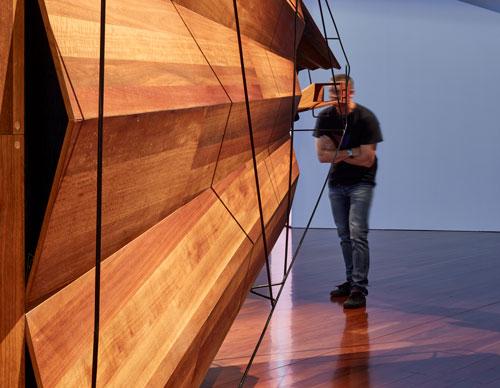
The exhibition, across both expansive floors of the gallery, is anchored between two navigational coordinates through the works Body Swap (2015) and Logos (2015). While most works in Stone Soup are replicas of modest everyday objects cast into pigmented polyurethane resin, Body Swap is constructed with a mirror and steel frame. Its visual ambiguity not only displaces the viewer into a two-fold participatory body-swap, it also hints at a double-meaning, where the viewer’s body in this instance, rather than the object, becomes the imitation or copy in the artist’s exchange.

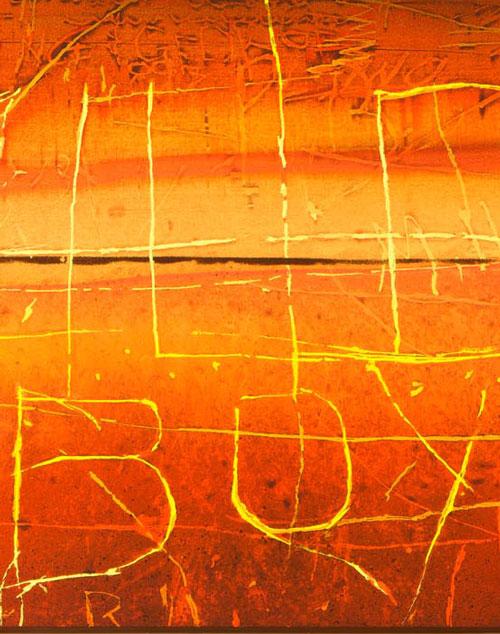
Titles are also pertinent to Armanious’s ingenious strategy of setting up a two-fold interchange. Carved in resin and made to appear as blu-tack randomly positioned on the wall Logos, almost concealed from view, augments the tongue-in-cheek tone of the exhibition. This approach critically reveals the artists’ examinations into the hierarchy of knowledge systems and is replayed across forms. Logos is fundamentally a Greek philosophical term meaning: word, ordering intelligence and the internal logic of the universe.
Its contemporary definition which refers to “a symbol which functions as a substitute for something else,” also transposes the complexity and paradoxical interplay, where the viewer becomes actively involved in decoding. Referencing the Western art historical canon, Weeping Woman (2012) continues this line of cross-mapping between convergent schemas and wordplay, the sculpture bears no resemblance to Pablo Picasso’s 1937 painting of Dora Maar. Rather, it appears more like a mythological totem pole or tree fern trunk.
Throughout the exhibition, the artist provides whimsical clues to the disjuncture between the thing being observed and what is perceived. Inviting us to think about the origins of pure form and their epistemological framework, as well as asking, what is not a replica of something else? Echoing Walter Benjamin’s proposition that language ‘may be seen as the highest level of mimetic behaviour,’[2] Armanious reminds us that language too is a conditioned mimetic device. Within this environment a perplexing equalisation of different mechanisms unfolds, where object, language, idea, authorship, artwork and imitation become interchangeable: disjuncture becomes a powerful tool in this artist’s method. Yet, at the same time, once an object is de-coded or recognised, the work’s aesthetic value as a self-governing artform is threatened.

Often described as part-shaman, part alchemist,[3] Armanious’ sculptures function as referential mapping devices or allegories – leading us closer to the real form while tracing the repetition back to the origin of ‘idea’. Remnants and residues are also preserved and re-positioned in the form of an artwork. Every object, idea, or title, points to something else as coexisting relations. This is also seen in works such as Coin (2013)–a constructivist assemblage featuring a resin replica of a water cracker as a substitute of the coin, or Wow (2024)–a gesture to Claes Oldenburg coat hangers, where Armanious confronts his viewer with a whole new set of aesthetic questions: what expectation do we impose on a work of art? And does a resemblance to something else obscure or disclose the intentionality and meaning of the work?
Stone Soup is a powerful critique of institutional pedagogy, object ontology and the post-modern condition where representation and signs replace the real. Drawing us into oscillations between knowing and unknowing, artificial and natural, and the copy and the real, the exhibition evokes Baudrillard’s statement that perhaps ‘copies no longer refer to anything real behind them.’ In other words, the real is so far removed from the original that the copy’s only function is to refer to other signs.

While works in the exhibition deceptively allude to being crafted from different materials, textures and weight, they are made from pigmented polyurethane resin, occupying a collective space that is reflexive, coalesced and of likeness–becoming a system of sensory and perceptual diversions.
Intensifying the efficacy of reenactment or mime, perhaps Armanious’s most important statement is revealed in his work Magic (2022). Disguising itself as a wall-stand, Magic is empty-nothingness, where ideas become like the passage of time–non-linear, anonymous and nameless without origin or endpoint: transcendent, spinning, splitting, forming and reforming into the void. In all their humble familiarity, the works offer a momentary redirection to the mechanisms at play, drawing our attention back to the experience of perception and the origin of ideas.

Footnotes
- ^ Dawn Ades, Neil Cox and David, Hopkins, Marcel Duchamp, (London: Thames and Hudson, 1999). Note Duchamp’s readymades were mass-produced objects, while Armanious’ works are unique/one-offs.
- ^ Walter Benjamin, On the Mimetic Faculty, Peter Demetz, ed., translated by Edmund Jephcott, (New York: Schocken Books, 1978), 722.
- ^ Rebecca Coates, Uncanny Nature, exh.cat., (Melbourne: Australian Centre for Contemporary Art, 2006).